

IQ-EQ Fund Performance Snapshot
Equity markets added 2.5% in the third quarter as measured by the MSCI World Index (net) in euro terms. The year-to-date return stood at 15.6% as at 30 September. The quarter opened with a sharp momentum reversal, as semiconductor stocks suffered their worst monthly declines since 2008 amid AI valuation scrutiny and escalating Middle East tensions that pushed Brent crude above $100 per barrel during July.
The second quarter earnings season, which unfolded across July and August, delivered exceptional results. S&P 500 earnings rose 31% over the previous year, the strongest growth outside of post-recession recoveries since 1992, with all sectors except utilities beating earnings and sales forecasts and energy revenues surging 42.5%. However, into September, sentiment deteriorated for a short period as AI industry leaders called for a slowdown in the technology's development, rattling the sector that had powered much of the year's rally, while rising oil prices pushed the 10-year Treasury yield to 5.3%, the highest level since 2007.
The Energy sector was the standout performer during the quarter, rising by 16.3% as the oil price moved higher. The Technology sector was the other big winner during the quarter, rising by 7.2%. Given its size in global indices, the sector was responsible for over 78% of the entire MSCI World quarterly return during the quarter.
Energy-intensive sectors such as Utilities and Industrials were the laggards as oil prices soared. The pressure on the Utilities sector was compounded by rising bond yields, which increase funding costs and make utility companies’ dividend yields less attractive in comparison with bonds. Moreover, the rising price of electricity in the US, brought about by data centre demand, has been gaining political attention in recent months, prompting fears of a regulatory backlash against utilities. The Industrials sector also had to deal with rising funding costs and the pressure on their customers from rising energy costs.
At IQ-EQ Fund Management, we focus on profitable businesses which generate persistent returns and have high levels of protection combined with competent management. We define these as quality businesses, and we expect them to perform irrespective of market volatility. In the long run, we believe these characteristics will deliver outperformance for our clients.
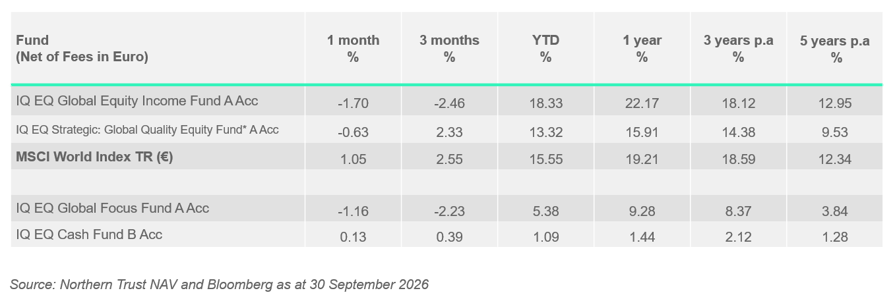
September 2026 figures for the IQ-EQ range of Funds:
IQ EQ Global Equity Income Fund: September Ret. YTD 18.33 % (Net of fees)
The IQ EQ Global Equity Income Fund returned -2.0% during the quarter, compared with the MSCI World Index, which rose by 2.5%. Stock Selection, Sector Selection and Currency Effects detracted from relative performance during the quarter. The Sector Selection outcome was driven by an underweight position in the Energy and Information Technology sectors and an overweight position in Utilities and Industrials. Merck and Pfizer were among the strongest contributors to equity performance during the quarter, while Corning and Cummins were laggards.
Key contributors during the period include:
+ Merck & Co. (MRK) Merck & Co. (MRK) is a global biopharmaceutical company with a portfolio spanning oncology, vaccines, cardiometabolic health, and animal health. Keytruda, its blockbuster cancer immunotherapy, remains the primary revenue driver. In 2026, MRK has been a standout large-cap pharma performer, with shares up ~40% year-to-date through Q3. The stock gained 14.5% over the quarter. In mid-July, FDA approval of Lipfendra, a cholesterol inhibitor, provided an early catalyst. Early in August, Q2 revenue of $16.6 billion beat consensus and full-year sales guidance was raised to $66.3–$67.3 billion. In mid-August, positive late-stage melanoma vaccine data drew mixed analyst reactions; late in the quarter, remigromig also met its primary endpoint in a diabetic macular oedema trial. Merck reiterated a >$70 billion long term commercial opportunity from over 20 pipeline products. Broad pipeline progress across multiple therapeutic areas positions Merck well to offset anticipated headwinds as Keytruda loses some of its current exclusivity.
+ Pfizer Inc. (PFE) is a global biopharmaceutical company developing medicines and vaccines across oncology, cardiovascular, rare disease, and infectious disease. Its key products include Eliquis, Vyndaqel, Padcev, and Paxlovid. By the end of Q3, the stock had delivered a YTD total return of 23.8% underpinned by non-COVID portfolio strength. On 4 August, the company reported Q2 revenue of $15.03 billion and earnings of $0.77 per share, both beating estimates, although the stock edged lower on the day as analysts called for more evidence of durable growth beyond the legacy portfolio. Mid-quarter, the EMA validated the marketing authorisation application for Pfizer's Lyme disease vaccine candidate. The stock rose approximately 21.0% over Q3, closing at $28.52. Management raised FY2026 revenue guidance to $60.5–$62.5 billion and reaffirmed adjusted EPS of $2.80–$3.00, targeting high single-digit revenue growth from 2028 to 2033. Despite near-term patent cliff headwinds, pipeline progression and cost discipline support cautious optimism around Pfizer's longer-term recovery.
- Corning Inc. (GLW) manufactures specialty glass, ceramics, and optical fibre, serving telecom, display, and life sciences markets. The company operates across five segments: Optical Communications, Display Technologies, Specialty Materials, Environmental Technologies, and Life Sciences. GLW is up 82.7% YTD, driven by strong AI-infrastructure demand for optical products. On 28 July, Q2 2026 results beat expectations, with earnings up 30% on the same period last year and Optical segment sales of $2.07bn up 32%. Nevertheless, Q3 core sales guidance of $4.9–$5.0bn fell marginally short of consensus, sending the stock down ~20% on the day; analysts subsequently cut their average price target by ca.16% post the results. Late in the quarter, multi-billion-dollar, multi-year fibre supply agreements with Verizon and AT&T reinforced long term demand, though a $2bn equity distribution agreement announced mid-quarter had weighed on sentiment. Management targets high-teens year-over-year revenue growth through Q4 and into 2027, with operating margins at or above 20%. Corning's expanding fibre supply agreements and AI-driven optical tailwinds underpin a constructive long term outlook.
- Cummins Inc. (CMI) manufactures diesel and natural gas engines, filtration, and power generation equipment. The company serves truck, industrial, and power markets globally across five segments. CMI is up 6% YTD having performed very strongly in the first and second quarters on data-centre-driven power demand. Early in the third quarter, CMI raised its dividend to $2.20 from $2.00 and announced a phased product launch plan following proposed changes by the US EPA to emissions regulations. On 4 August, Q2 2026 results showed record net sales of $9.46bn, but earnings per share of $6.73 missed consensus of ~$7.15 and gross margins of 26.1% fell short, sending the stock down ~11% at the open before recovering to close ~2% lower. Mid-quarter, Cummins secured its largest-ever battery energy storage system contract for a US data centre; late in the quarter, analysts cut their average price target on EPA policy and data-centre concerns, contributing to a ~27% Q3 decline. Management targets 2026 EBITDA of 18% to 18.5% and revenue growth of 10% to 13%, with H2 expected to be stronger than H1. Despite the Q3 selloff, Cummins' record revenue, growing power backlog, and data-centre exposure should support the stock in the long term.
IQ EQ Strategic: Global Quality Equity Fund*: September Ret. YTD 13.32 % (Net of fees)
The IQ EQ Strategic: Global Quality Equity Fund returned 2.3% over the quarter, compared with the MSCI World Index, which returned 2.5%. The Fund's performance was driven by negative Stock Selection combined with a positive outcome from Sector Allocation. There was no impact on relative performance from Currency Effects. The positive Sector Allocation outturn was driven primarily by sector underweight positioning in Utilities and overweight positioning in Health Care. The negative contribution from Stock Selection was due to the poor performance of stocks such as KLA Corp and Applied Materials.
Key contributors during the period include:
+ Microsoft Corp. (MSFT) develops and licenses software, cloud services, and hardware, serving consumers and enterprises globally. Its Azure cloud platform and Microsoft 365 suite anchor its AI-driven growth strategy. The shares had a torrid start to the year, falling by 20%, weighed down by elevated AI capital expenditure concerns in the first half. Early in the third quarter, Microsoft launched a 6,000-person AI adoption division and announced an Xbox overhaul cutting 3,200 jobs and divesting studios. On 29 July, quarterly results showed revenue of $90.0bn (+18% YoY) and earnings per share of $4.81, both beating estimates, with Azure growing 43% in constant currency — its fastest pace since 2022. The stock surged 15% the following day, driving a 38.6% Q3 gain. Early in September, Microsoft reorganised into two reporting segments and announced plans to more than triple data-centre capacity to 38GW by 2032. As the quarter came to an end, the company was in a reasonably strong position as Azure was re-accelerating, Copilot seats had surpassed 30 million, and the company had a $678bn commercial backlog.
+ Recruit Holdings Co. (6098) is a global human resources technology company, operating the Indeed and Glassdoor job platforms alongside staffing and matching businesses. The company operates across three segments: HR Technology, Matching & Solutions, and Staffing. In 2026, the stock had performed strongly, supported by growing confidence in AI-driven monetisation at its technology platform, Indeed. The stock set multiple record highs through July, rising ~48% in Q3, as pre-earnings momentum built on expectations of an AI-fuelled guidance upgrade. On August 7th, quarterly results showed revenue of ¥1.05tn (+19% YoY) and operating profit of ¥255bn (+66% YoY), both well ahead of consensus; the stock surged 23% on the day. The stock continued to set record highs through late August and into September, aided by an Indeed FutureWorks product event and analyst price target upgrades. With AI accelerating Indeed adoption, a record earnings beat, and a sharply upgraded outlook, Recruit was among the strongest contributors to performance in Q3.
- KLA Corp. (KLAC) supplies process control and yield management solutions for the semiconductor industry, helping chip manufacturers improve yields and manage defects across advanced fabrication nodes. KLAC shares have performed strongly in 2026 despite a sharp Q3 pullback. Shares fell sharply early in the quarter ahead of earnings. On 28 July, KLA reported quarterly revenue of $3.66B (+15% YoY) and earnings per share of $1.05, both beating consensus, although free cash flow and gross margin disappointed, driving a further decline. The stock fell 34.9% over Q3 in total, with analysts trimming the average price target to $234 from $241 post-results. The shares rallied somewhat in September as the technology sector recovered from an early-quarter selloff. KLA expects an acceleration in revenue and profit in the quarters ahead.
- Applied Materials Inc. (AMAT) develops, manufactures, and services semiconductor wafer fabrication equipment for the global semiconductor industry. Its tools serve chipmakers across leading-edge semiconductor products and applications. In 2026, AMAT shares have doubled in the year to end-September despite a sharp Q3 pullback. The shares fell early in the quarter as the company reported fiscal Q3 revenue of $9.12B (+21% YoY) and earnings per share of $3.50, both beating consensus. However, free cash flow declined due to higher capex, sending the shares down 5% the following session. The stock fell 28.7% over Q3 despite analysts raising the average price target to $654 from $634 post-results. In mid-September, the shares hit a quarter low before recovering 23% into period-end, supported by a $5bn India investment pledge and the announcement that Japanese memory chip maker Kioxia would join the AMAT’s EPIC Centre partnership for the development of next-generation memory products.
IQ EQ Global Focus Fund: September Ret. YTD 5.38 % (Net of fees)
The IQ EQ Global Focus Fund returned -2.2% during the quarter. The equity portfolio returned -2.1%, while the bond holding returned -5.7%. Within the equity book, Merck and ADP were among the best performers, while the biggest detractors from performance included Corning and Cummins.
Key contributors during the period include:
+ Merck & Co. (MRK) Merck & Co. (MRK) is a global biopharmaceutical company with a portfolio spanning oncology, vaccines, cardiometabolic health, and animal health. Keytruda, its blockbuster cancer immunotherapy, remains the primary revenue driver. In 2026, MRK has been a standout large-cap pharma performer, with shares up ~40% year-to-date through Q3. The stock gained 14.5% over the quarter. In mid-July, FDA approval of Lipfendra, a cholesterol inhibitor, provided an early catalyst. Early in August, Q2 revenue of $16.6 billion beat consensus and full-year sales guidance was raised to $66.3–$67.3 billion. In mid-August positive late-stage melanoma vaccine data drew mixed analyst reactions; late in the quarter, remigromig also met its primary endpoint in a diabetic macular oedema trial. Merck reiterated a >$70 billion long term commercial opportunity from over 20 pipeline products. Broad pipeline progress across multiple therapeutic areas positions Merck well to offset anticipated headwinds as Keytruda loses some of its current exclusivity.
+ Automatic Data Processing Inc. (ADP) provides cloud-based human capital management and business outsourcing solutions globally. The company serves over 1.1 million clients across 140 countries through two segments: Employer Services and Professional Employer Organisation (PEO) Services. ADP entered Q3 down 9.1% YTD, weighed by macro headwinds and labour market softness in the first half. However, the stock rose by 16.7% during Q3, recovering ahead of late-July earnings release, with analysts lifting their average price target to $295 from $244 early in the quarter. On 29 July, ADP reported Q4 earnings and revenue, which both beat market estimates. This lifted the stock 3.5% on the day as analysts raised their average price target by 13% post the results. Early in September, ADP expanded its strategic partnership with Amazon Web Services to accelerate AI transformation across its client base. Management indicated higher revenues and profits, with margin expansion. ADP exited the quarter with record client retention of 92.1%, expanding AI capabilities, and a resilient payroll base.
- Corning Inc. (GLW) manufactures specialty glass, ceramics, and optical fibre, serving telecom, display, and life sciences markets. The company operates across five segments: Optical Communications, Display Technologies, Specialty Materials, Environmental Technologies, and Life Sciences. GLW is up 82.7% YTD, driven by strong AI-infrastructure demand for optical products. On 28 July, Q2 2026 results beat expectations, with earnings up 30% on the same period last year and Optical segment sales of $2.07bn up 32%. Nevertheless, Q3 core sales guidance of $4.9–$5.0bn fell marginally short of consensus, sending the stock down ~20% on the day; analysts subsequently cut their average price target by ca. 16% post the results. Late in the quarter, multi-billion-dollar, multi-year fibre supply agreements with Verizon and AT&T reinforced long term demand, though a $2bn equity distribution agreement announced mid-quarter had weighed on sentiment. Management targets high-teens year-over-year revenue growth through Q4 and into 2027, with operating margins at or above 20%. Corning's expanding fibre supply agreements and AI-driven optical tailwinds underpin a constructive long term outlook.
- Cummins Inc. (CMI) manufactures diesel and natural gas engines, filtration, and power generation equipment. The company serves truck, industrial, and power markets globally across five segments. CMI is up 6% YTD having performed very strongly in the first and second quarters on data-centre-driven power demand. Early in the third quarter, CMI raised its dividend to $2.20 from $2.00 and announced a phased product launch plan following proposed changes by the US EPA to emissions regulations. On 4 August, Q2 2026 results showed record net sales of $9.46bn, but earnings per share of $6.73 missed consensus of ~$7.15 and gross margins of 26.1% fell short, sending the stock down ~11% at the open before recovering to close ~2% lower. Mid-quarter, Cummins secured its largest-ever battery energy storage system contract for a US data centre; late in the quarter, analysts cut their average price target on EPA policy and data-centre concerns, contributing to a ~27% Q3 decline. Management targets 2026 EBITDA of 18% to 18.5% and revenue growth of 10% to 13%, with H2 expected to be stronger than H1.
IQ EQ ESG Multi-Asset Fund:
The Fund was closed on 25 September.
IQ EQ Cash Fund: September Ret. YTD 1.09 % (Net of fees)
The gross running yield on the Cash fund at the end of September was 2.24% as the ECB continues to monitor inflation, European infrastructure spending as well as the impacts of geopolitical events such as conflict in the Middle East to the current cycle of monetary policy. The Fund Management team continues to maintain ca. 30% of the fund in short-term liquidity & short-dated government bonds, blended with deposits termed out for different maturities out to a maximum of one year.
The ECB Governing Council raised interest rates by 0.25% as anticipated in September, with officials reiterating a data-driven and meeting-by-meeting approach to monetary policy. The accompanying statement noted that ‘the conflict in the Middle East continues to generate inflation pressures, and inflation is set to remain well above target for an extended period’, while ‘the outlook remains highly uncertain, with risks to the upside for inflation and to the downside for economic growth’. ECB President Lagarde added that the conflict in the Middle East coupled with Russia’s war in Ukraine has pushed the path of energy prices up further and that rising bond yields are ‘not a euro-specific issue’. ECB Governing Council member Schnabel stated that the energy shock caused by the conflict in the Middle East is proving to be more sustained than initially thought and is spreading beyond just oil. Schnabel added that initially it was questioned if this would be a short-lived event, but that unfortunately ‘it is much more persistent’.
Data released by the Ifo Institute in Germany indicated that Gross Domestic Product (GDP) is anticipated to increase by 1.3% this year, up from 0.6% previously estimated. The institute’s expectations gauge hit 90.4, up from 89.1 the previous month and ahead of the 89.3 estimated by economists. Commenting on the latest report, Ifo President Fuest said that ‘the recovery we’ve been seeing for a couple of months now is continuing and it’s pretty much across the board’.
Key contacts
If you have any queries please contact Timothy.Kelly@iqeq.com. or any member of our sales team at assetmanagement@iqeq.com. Additional information on the Davy Funds Plc range of funds can be found on our website here.
************************************************
WARNING: Past performance is not a reliable guide to future performance. The value of investments may fall as well as rise. Investments denominated in non-euro currencies, may be affected by changes in exchange rates when converted to euro or other currencies.
* Effective 1st May 2024 the IQ EQ Fund Management (Ireland) Limited managed sub-funds on the Davy Funds Plc umbrella were renamed removing “Davy” from the name and/or including “IQ EQ”. ( Davy Global Equity Income Fund to IQ EQ Equity Income Fund; Davy Strategic: Global Quality Equity Fund to IQ EQ Strategic: Global Quality Equity Fund; Davy Global Focus Fund to IQ EQ Global Focus Fund; Davy ESG Multi-Asset Fund to IQ EQ ESG Multi-Asset Fund, and Davy Cash Fund to IQ EQ Cash Fund). There has been no change to the investment objective or process.
IQ EQ Fund Management (Ireland) Limited is regulated by the Central Bank of Ireland. Details about the extent of our authorisation and regulation by the Central Bank of Ireland are available from us upon request.